|
USS HARTFORD
A copy of this model is at
the Texas Civil War Museum
In
1857, Congress had authorized construction of five
sailing warships with auxiliary seam power. The Hartford
was
one of them.
Her keel of white oak was
laid in January, 1858 at
Boston Navy Yard.
265 feet long and 44 feet
wide,
USS Hartford
was launched by November
of that year. Her two steam engines were built
under the supervision of Jesse Gray, chief engineer in
the U.S. Navy. Her tall smokestack was of a unique type
which could be partially telescoped when the her engines
were not used.
After sea trials in 1859, the Hartford
left
for her first tour of duty as flagship of the East Indies Squadron
in Asia. The powerful warship
embarked the American Minister
John Elliott Ward
to China in Hong Kong and then carried him to Canton, Manila, Swatow, Shanghai, and other Far Eastern ports to settle American claims and to arrange
foreign affairs for the United States.
.jpg)
In April 1861, the Confederates attacked
Fort Sumter. President Lincoln declared war and
proclaimed a blockade of the southern ports from South
Carolina to Texas. In Washington a plan was brewing with the
goal of capturing New Orleans, ninety miles up the
Mississippi River from the Gulf of Mexico. If the North
controlled the Mississippi, the Confederacy would be
split in two. The plan required a man who was loyal to
the Union, acquainted with the Mississippi River, and
who had years of experience at sea. That man was Captain
David Farragut, at the age of 61. Farragut was made
Flag Officer -- commander
of the newly created West Gulf Blockading Squadron. His
flagship was the USS Hartford.
Later that
year (1861) the Hartford
sailed
to the Philadelphia Navy Yard for the installation of more
guns. She departed the Delaware Capes on 28 January.
Subsequently, USS Hartford participated in the Battle of New
Orleans in April and May 1862, the Siege of Vicksburg a
year later, and the decisive Battle of Mobile Bay in August 1864.
After the civil war,
USS Hartford
became the flagship to the new Asiatic Station
Squadron, sailing the Pacific until decommissioned in California in January 1887 for apprentice
sea-training duty.
In 1912,
Hartford
became the station ship
at Charleston, South Carolina. In October 1938, she
moved to Washington, D.C., with the intent for her to be
a museum ship. However,
World War II changed everything, and also Hartford's
fate.
In October 1945, she was towed to
Norfolk, Virginia, classified as a relic. The ship was
allowed to deteriorate, and as a result, she sank at her
berth on 20 November 1956. She proved to be beyond
salvage and was subsequently dismantled. Her 400-pound
bell is now displayed in Constitution Plaza in Hartford
City, CT.
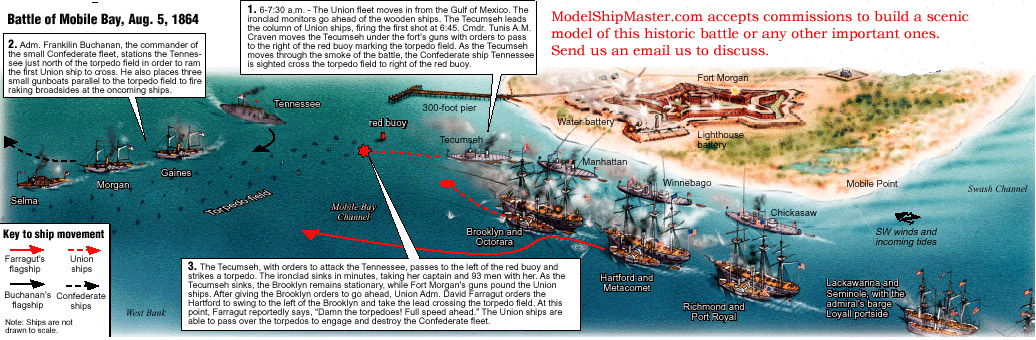
The Battle of Mobil Bay:
In the
early fall of 1864, Admiral David Farragut’s fleet
attacked Mobile Bay--the last strategic Confederate
port.
Mobile Bay was a Confederate industrial center still building ships and turning out war supplies.
The port's formidable
defenses included a series of forts, mines, and
obstructions. By 1864, David Farragut was tasked with
capturing the bay. Operations began on August 2, 1864.
After taking Fort Gaines on Dauphin Island and Fort
Morgan on Mobile Point, Union forces cut off Mobile from
open trade.
The Battle of Mobile Bay took place
on August 5th, 1864.
Admiral
Farragut, aboard his flagship USS Hartford, led a fleet
consisting of 4 ironclads and 14 wooden vessels. The
Confederate naval force, backed by the powerful guns of
Forts Morgan and Gaines in the Bay, was composed of the
powerful newly-built ram Tennessee which was Admiral
Franklin Buchanan's flagship, and steamers Selma,
Morgan, and Gaines. From the firing of the first gun by
Fort Morgan to the raising of the white flag by the
CSS Tennessee, little more than 3 hours elapsed— 3
hours of terrific fighting on both sides.
It was at the Battle of
Mobile Bay that Farragut was reported saying the famous
line, “Damn the torpedoes, full speed ahead!”
The Confederates had only 32 casualties, while the Union
forces suffered 335.
In the Battle of Mobile Bay, a handful of ships and men
had won a great decisive victory that secured the South
could not win the war.
Twelve
of Hartford's crew received the Medal of Honor.
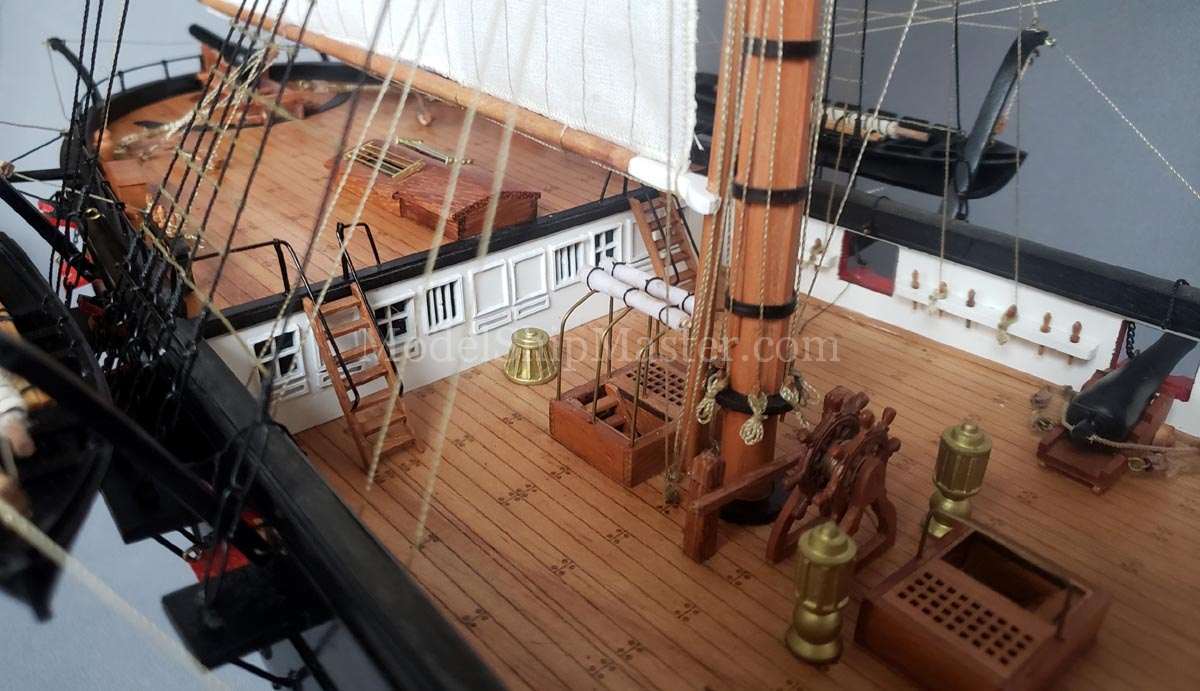
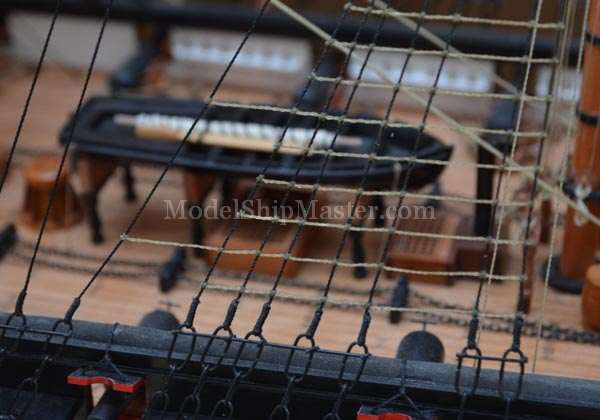 .jpg)
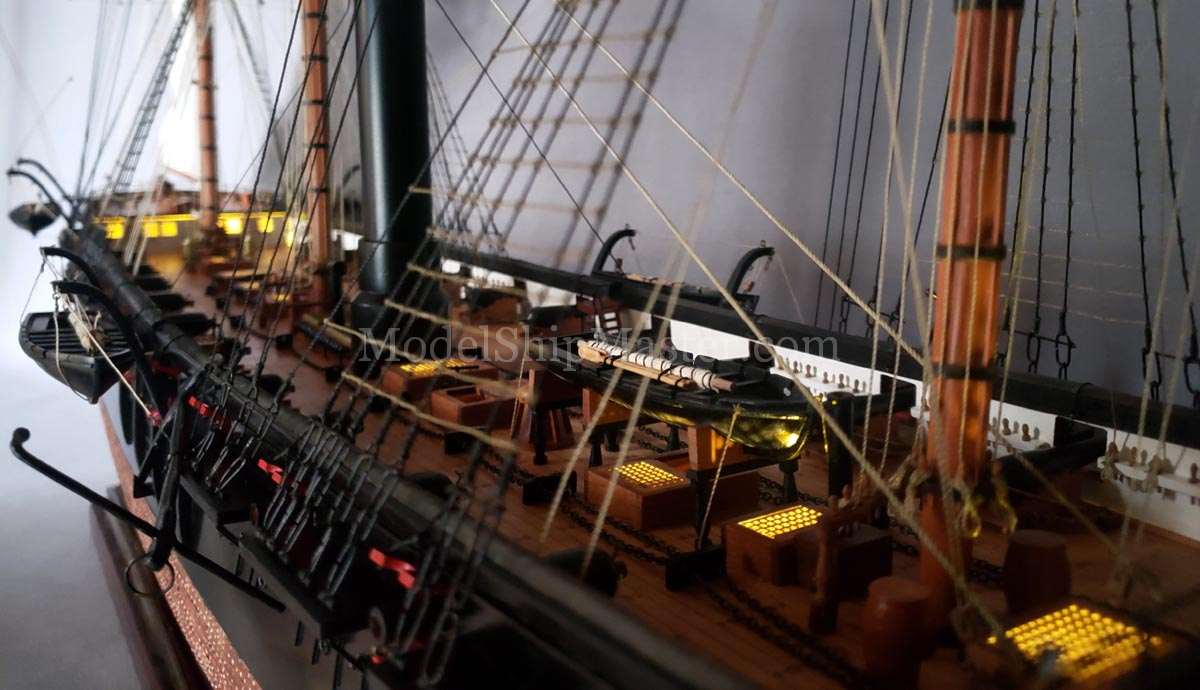
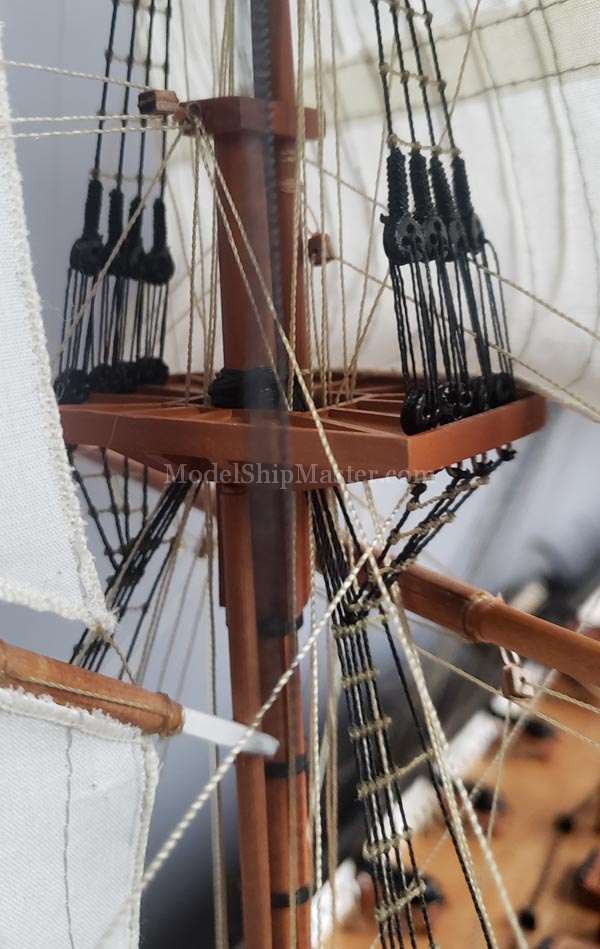
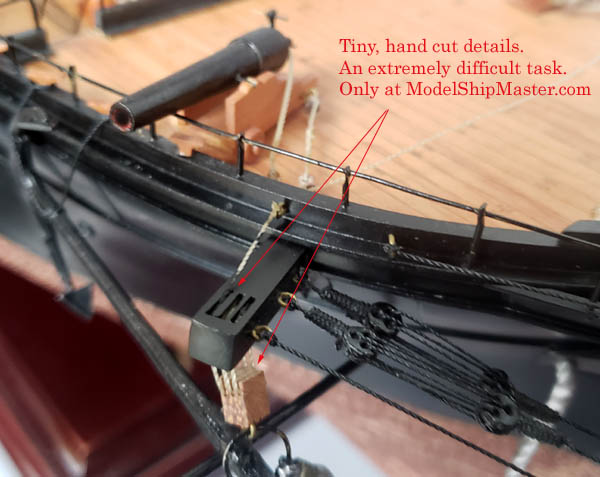
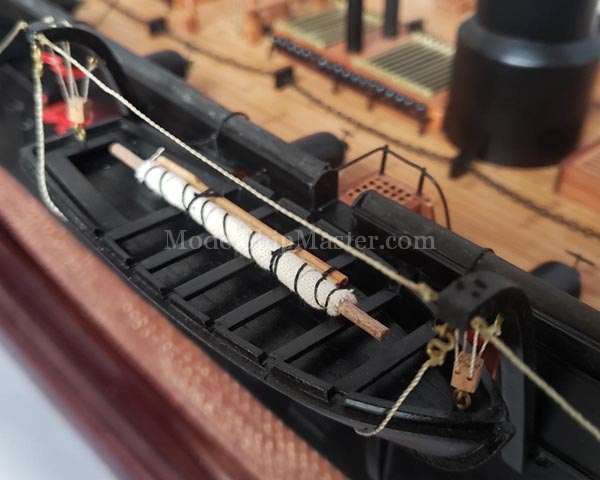
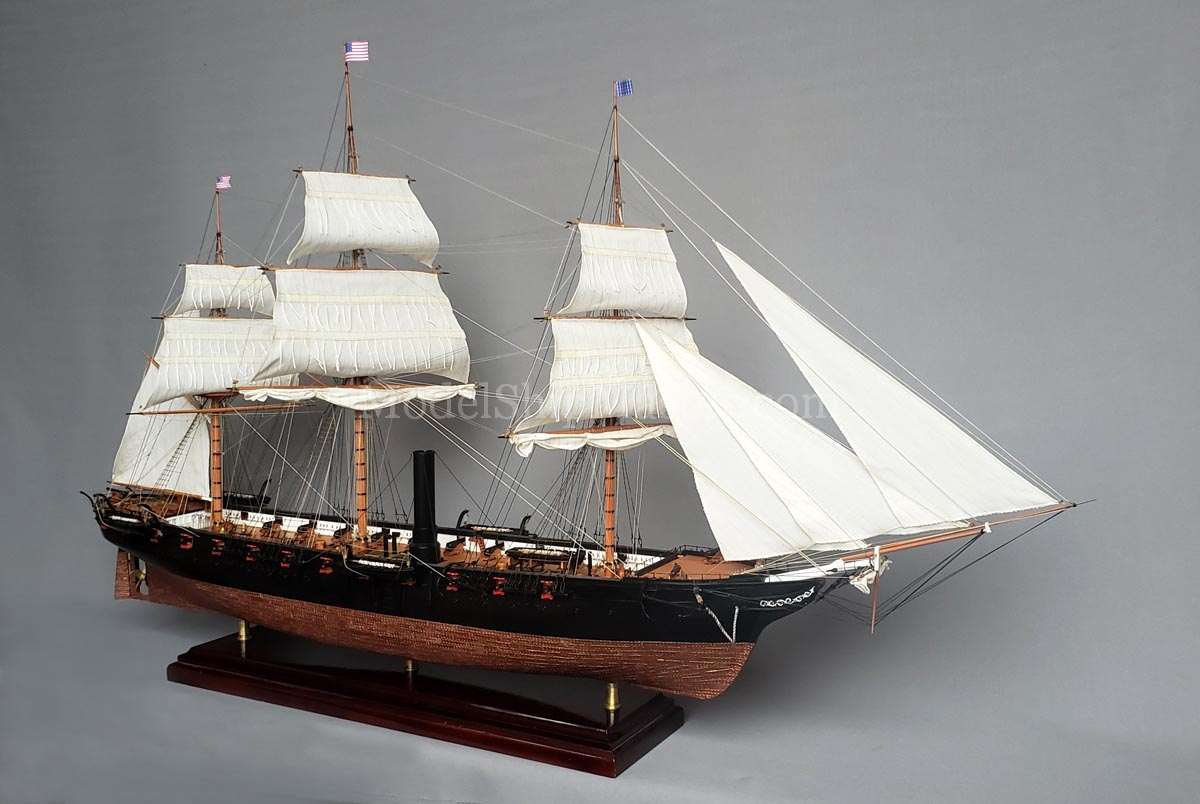
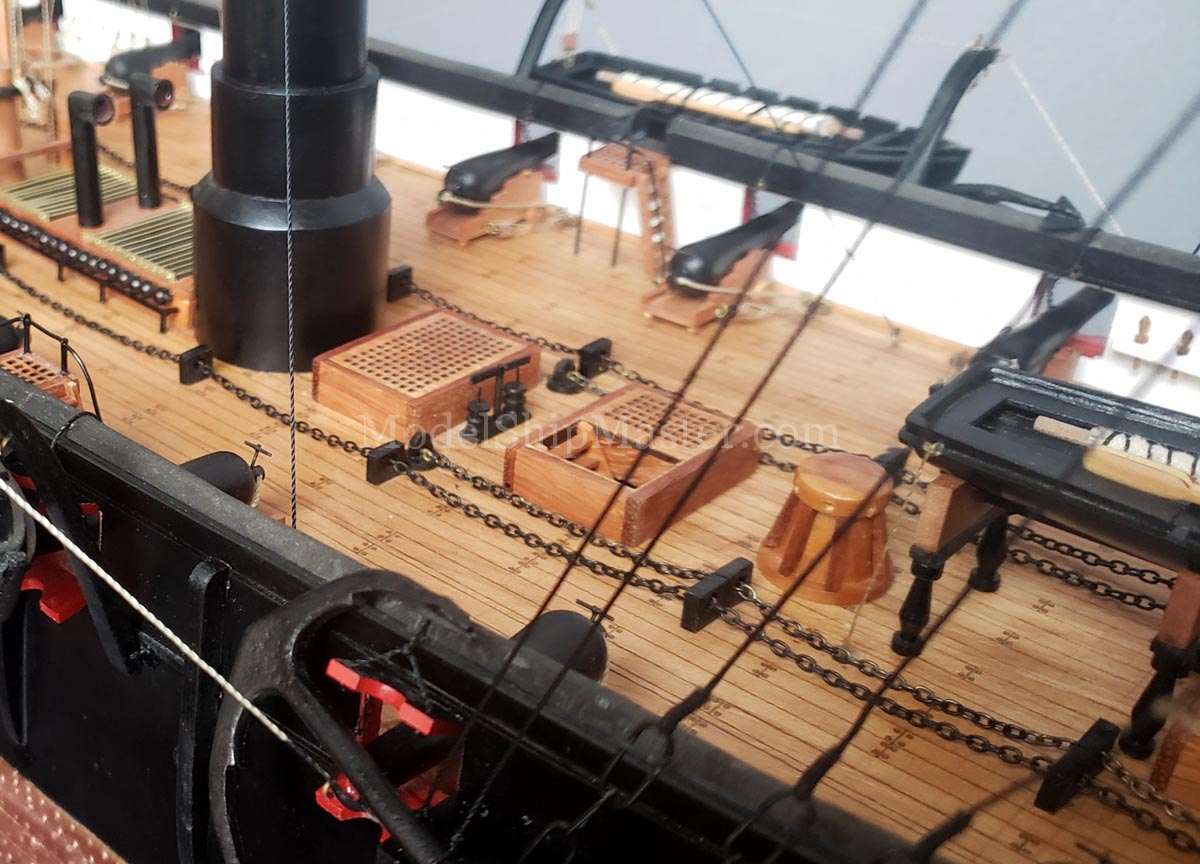
We offer this
primarily wood model of the USS Hartford in two
sizes:
40" long x 24" tall x
9" wide.
$4,530
Shipping and insurance in
the contiguous USA included.
Other places: $400 flat rate.
Add
light featq1ure
(standard 9 v battery):
$300.
Available on this large size only.
24" long x 20" tall x
7" wide.
$2,990
Shipping and insurance in
the contiguous USA included.
Other places: $300 flat rate.
Models are made to
order only.
We require only a small commitment deposit to start
the model $900
 The remaining balance won't be due until the model
is completed, in about four months for the small
size and nine months for the large. The remaining balance won't be due until the model
is completed, in about four months for the small
size and nine months for the large.
Other ship, different size? Just let us know by clicking
on this link: Commissioning. The
process will be easy and stress free.
"I received them yesterday [4/8/2014] and they were
magnificent.Thank you. Look forward to the next two
ships.Regards, Hans."
"You guys sure do beautiful work!
My fleet is up to 3 of your ships, Glatton, Hartford and
PT 109, and I think they are all great.The new Hartford is outstanding...Please keep me in the
loop for any deals you have going from time to time.Thanks for sharing. Mike"
"I
thought I would let you know how much I am enjoying
looking at the Hartford, and how proud I am to have a
small input in the new build and wondered if you have
had any interest show in your new web page. I am
sure the Hartford was an incentive to shake of
the hospital " blues " and it has already given me great
pleasure and it will become a family heirloom for the
family in years to come! it is a great piece of the
model shipwright art! she is absolutely beautiful ! I
have enjoyed our exchange of e-mails through the build,
and feel you are now a friend ! I wish you all the best
for the future, good luck and again many thanks,
Kindest Regards
Frank"
"The
Hartford arrived yesterday: FANTASTIC piece of art!!! I really liked the
way it was crated – amazing. I took the crate apart screw by screw, and
the only mishap I had was that I busted the life boat hanger on one side
when I pulled the blue tape off, but I think I will be able to repair.
Looks great on the mantel. I will be in the market for another one of
your ships very soon. Thanks for the excellent work! Mike R."
Learn more about the USS
Hartford here:
https://en.wikipedia.org/wiki/USS_Hartford_(1858)
|